Why late-night service is a gift for them
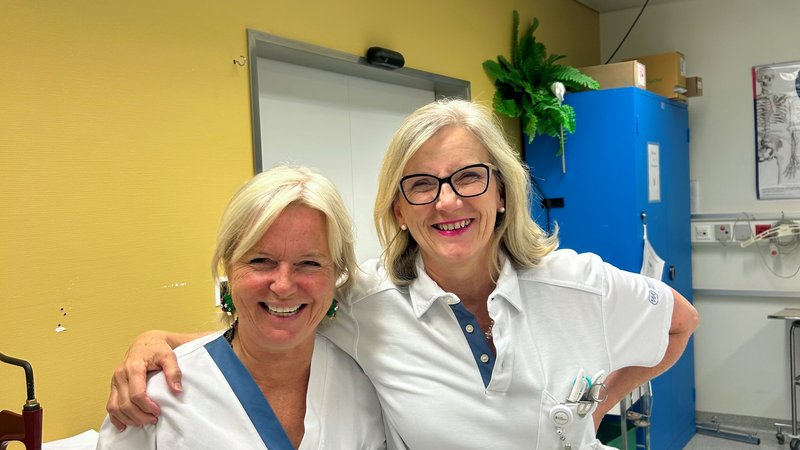
Late shift sounds like a long evening. For Bea and Charlotte, it means that the day belongs to them.
Charlotte puts it in a nutshell: "I really like working late because it really extends my day. I live in Meilen, so I have quite a short commute to work and can do a lot on days like this until 2 or 2.30 and only then do I have to leave the house to start my late shift. I really appreciate that."
Bea also likes exactly that: time in the morning, time for life. At the same time, she says clearly: "For us, late shifts are much stricter overall than early shifts."
When the evening comes, the wave comes
Why stricter? Because the evening in the emergency room is often the time when many things come together. People come in after work, after sport, after the football tournament where they sprained their ankle. Or because something has been hurting all day and is now unbearable.
Charlotte explains why this often happens in the evening: "Pain at night is simply more unpleasant than during the day because you focus on it more."
And sometimes it is even surprisingly predictable. After snowy Sundays, for example. First you only notice a tugging sensation on the way home, then it gets stronger at home and suddenly many people are sitting in the waiting area with "not so minor" injuries.
No dinner, but chocolate instead
There's a question that's almost a running joke on the late shift: when do we actually have dinner?
Bea says: "The special thing about the late shift is that we often don't have time for dinner."
Instead of a comfortable break, it often comes down to quick interim solutions. And these have their own reputation in an emergency.
Bea laughs: "So the emergency is the hospital's culinary hub. We always have everything full of sweets."
You take breaks where you are immediately ready to go again. "Because if something happens, we have to jump straight in," says Charlotte.
When every minute counts
In potentially life-threatening situations, a shock room is announced. The paramedics register, an internal alarm is raised and the team gets ready. When the patient arrives, there is first a short, structured handover. What has happened? What is their condition? What has already been done? Then care starts immediately.
For Bea, the crucial thing is that no one is alone in this room. "When a patient comes to the shock room, it means that someone is in the room with them the whole time and doesn't leave their side until the situation has been resolved. It may be a quarter of an hour, it may be three hours."
While everything in the shock room is focused on this one person, the rest of the emergency ward continues to run. This is exactly where teamwork becomes apparent in everyday life. Tasks are distributed, other patients are taken on so that operations do not come to a standstill.
Stories that only emergencies write
Being on emergency duty brings situations that you can't plan for. And stories that you hardly ever tell anyone later because they would sound too absurd.
Bea says: "I could tell you 3 hours of emergency stories... once we had a patient who was transferred by ambulance because she had swallowed glass.
We first took her to a bunk to calmly assess the situation. When we heard the crash, we immediately went back inside and saw her spitting the fluorescent tube of our lamp like a grain stalk."
Young people who underestimate alcohol also come in the evening. It is not uncommon for parents to end up completely overwhelmed at the emergency because they have never seen their child like this before and because the mixture of speed, group dynamics and drinks was stronger than expected.
And Charlotte comes up with a sentence that shows exactly how broad the spectrum is:
"I've also seen men peeing on the wall like a dog in the emergency ward."
In between all this, however, there are also moments that are not strange, but sad. Cases that show how lonely people can be. And how quickly a fall at home can become an absolutely exceptional situation when no one notices that something has happened.
Christmas Eve in an emergency is festive and serious at the same time
On Christmas Eve, between triage and phone calls, there are sometimes flashes of something festive: Christmas tree earrings, Santa hats, a brief moment together if the situation allows.
And yet they both notice that the more urgent cases often come on Christmas Eve. Minor complaints tend to be suppressed so as not to spoil the festivities. And sometimes the opposite happens: for example, when relatives want someone to stay in hospital on Christmas Eve, even though it would be medically possible to discharge them.
The beauty of the job
What drives both: Effectiveness. Doing something noticeably good in a short time.
"There are many wonderful stories, because most people who come to the emergency room leave it pain-free, healthier or reassured," says Charlotte.
And sometimes a moment like that sticks.
The moment that lasts
Charlotte: "I have the ability to erase my memory of work when I take off my work clothes. I don't dwell on the things that happened."
It's different with Bea. She could go on at length. But one story sticks in her mind in particular. Bea talks about a patient who had suffered a massive heart attack. She sensed his fear, this all-pervasive fear. And she gave him an anchor in the midst of the pain and panic. Not a medical one. Humanly. She told him to hang in there, that it would continue straight away, that help was there. "You can't die, you're younger than me. You're hanging in there now." He later came back for further treatment and told her that these words had helped him. Bea says she still gets goosebumps today when she thinks about it.
After midnight. Take a quick breath
When the shift ends and the evening is over, they sometimes sit outside together for a few minutes. A few minutes before going home. A moment of teamwork. Silent night.
About the people
Bea Bucher has been working in nursing for over 40 years and has been at Männedorf Hospital since 2008. She is a qualified NDS emergency nursing expert.
Charlotte Züllig has been at Männedorf Hospital since 2017 and has been working in nursing for 33 years. She is also an emergency nursing expert.